 how-to
How to Find Reliable 24/7 Caregivers for Your Loved One
Table of Contents
- Signs Your Loved One Needs 24/7 Caregivers
- Live-In Care vs. 24-Hour Care: Understanding the Difference
- Private Caregiver vs Agency: Which Option Fits Your Situation
- Caregiver Background Check Requirements You Should Expect
- Questions to Ask Home Care Agencies Before You Commit
- Average Cost of 24-Hour Home Care and Financial Assistance Options
- How to Build a Personalized Care Plan for Reliable 24/7 Caregivers
- Frequently Asked Questions
Last Updated: August 13, 2026
Finding reliable 24/7 caregivers is one of the most consequential decisions a family will ever make, and getting it wrong carries real consequences for the person who depends on that care every single day. At Katys home healthcare, we've guided families through this process for over a decade, and the same pattern appears repeatedly: families wait too long, rush the search, and end up with a caregiver who isn't the right fit. This guide walks you through every stage, from recognizing when continuous care is genuinely needed to building a personalized care plan that holds up over time. Below, we cover the questions most families never think to ask, the contractual traps worth watching for, and the technology tools that are quietly changing what around-the-clock support looks like in practice.
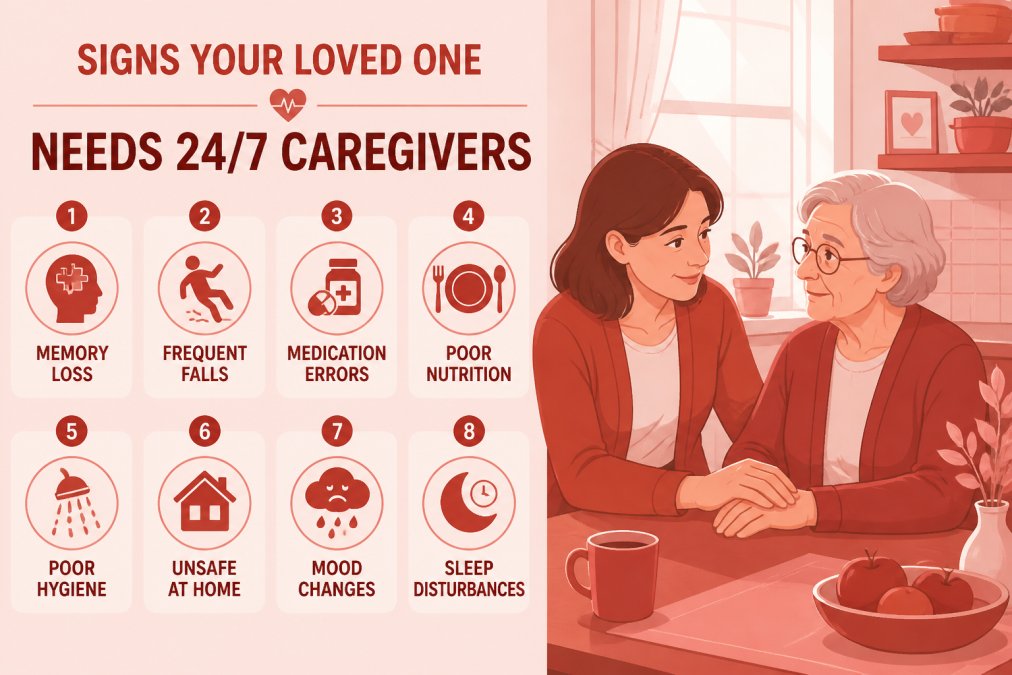
Signs Your Loved One Needs 24/7 Caregivers
Recognizing the need for continuous care is harder than it sounds. Most families don't identify a single crisis moment; they notice a slow accumulation of warning signs that are easy to rationalize away one at a time.
Physical and Cognitive Warning Signs
The clearest indicators that part-time support is no longer enough include:
- Frequent falls or near-misses, especially at night when no one is present
- Difficulty managing medication schedules, including missed doses or double dosing
- Declining hygiene or inability to complete daily living activities independently
- Wandering behavior or confusion about time and place, particularly in cases of dementia
- Unexplained weight loss, dehydration, or signs that meals are being skipped
- Recent hospitalization with a recovery that requires ongoing mobility assistance
A single item on that list may not signal an emergency. Several of them together, or any one of them worsening quickly, usually does. The National Institute on Aging's guidance on long-term care offers a practical framework for assessing when a loved one's needs have outpaced what family support alone can provide.
When Family Caregiver Burnout Becomes a Factor
The thing nobody tells you about family caregiving is that burnout doesn't announce itself. It arrives gradually, disguised as exhaustion, irritability, and a creeping sense that you're failing at everything: your job, your relationships, and the care itself.
Caregiver burnout is a legitimate medical concern, not a sign of weakness. When a primary family caregiver is running on empty, the quality of care declines for everyone involved. Bringing in professional 24/7 caregivers isn't giving up. It's recognizing that consistent, compassionate care requires more than love alone.
Respite care, where a professional steps in so family members can rest and recover, is often the first step before transitioning to full around-the-clock support.
Live-In Care vs. 24-Hour Care: Understanding the Difference
Live-in care is an arrangement where a single caregiver lives in the home and provides support throughout the day, with the expectation of a sleep period of several hours overnight. This model works well for clients who don't require assistance during nighttime hours but need consistent daytime supervision and help with daily living activities.
24-hour care involves a rotating team of caregivers who cover the full day and night in shifts, ensuring someone is awake and available at all times. This model is appropriate for clients with advanced dementia, significant fall risk, or medical conditions requiring continuous monitoring.
The distinction matters practically. Live-in care typically costs less because caregivers are compensated for fewer active hours. But for a senior who wanders at night, gets up frequently, or requires medication management around the clock, live-in care creates coverage gaps that can be dangerous. Be honest about your loved one's nighttime needs before settling on a model.
| Care Model | Caregiver Arrangement | Best For | Key Limitation |
|---|---|---|---|
| Live-in care | One caregiver, lives in home | Clients needing daytime support | Overnight gaps if client is active |
| 24-hour care | Rotating shift caregivers | High-need, overnight supervision | Higher staffing cost |
| Hourly/part-time | Scheduled visit windows | Early-stage needs | Not continuous coverage |
Private Caregiver vs Agency: Which Option Fits Your Situation
Most families face this choice early in the search process, and the right answer depends on how much administrative responsibility you're prepared to take on.
Pros and Cons of Each Approach
Private caregivers are hired directly by the family without an agency intermediary. The potential advantages include lower hourly rates and more direct control over who is in your home. The drawbacks are significant: you become the employer of record, which means handling payroll taxes, workers' compensation, backup coverage when the caregiver is sick, and conducting your own caregiver background check and reference verification.
A common mistake is underestimating how quickly those administrative burdens accumulate, especially during a health crisis.
Caregiver agencies manage recruitment, screening, training, scheduling, and supervision. They carry liability insurance, handle payroll, and provide substitute caregivers when your primary caregiver is unavailable. Continuity of care is more reliably maintained because the agency has a bench of trained staff. The trade-off is that agency care generally costs more per hour, and families have less direct influence over which specific caregiver is assigned.
For most families seeking genuine 24/7 caregivers, an agency model offers better long-term reliability, particularly when continuity of care and caregiver credentials matter most.
Caregiver Background Check Requirements You Should Expect
Background verification is non-negotiable when someone will be living in or regularly entering your loved one's home. Reputable agencies conduct thorough screening before any caregiver is placed with a client.
At minimum, caregiver background check requirements should include:
- Criminal history check covering state and federal databases, including sex offender registries
- Identity verification to confirm the caregiver is who they claim to be
- Employment history verification with direct contact to previous employers
- Professional license or certification check where applicable, such as for home health aides or certified nursing assistants
- Driving record check if the caregiver will transport the client
- Drug screening, ideally at hiring and periodically thereafter
The U.S. Department of Health and Human Services guidance on home care worker screening outlines the federal standards that inform state-level requirements for home care worker background checks. Individual states, including Ohio and North Carolina, have their own additional requirements that agencies operating in those states must follow.
Ask any agency you're evaluating to walk you through their specific screening process. If they're vague or defensive, that's a red flag.
Questions to Ask Home Care Agencies Before You Commit
The interview process with a home care agency should feel like due diligence, not a sales call. Come prepared.

Strong questions to ask home care agencies include:
- How do you match caregivers to clients, and can we meet the caregiver before they start?
- What is your caregiver turnover rate? High turnover is a direct indicator of management problems.
- How do you handle overnight emergencies, and what are your emergency protocols?
- Are your caregivers employees or independent contractors? Employees come with agency liability coverage; contractors often don't.
- What training do caregivers receive, and is dementia or Alzheimer's care training included?
- How do you handle caregiver supervision and quality assurance?
- What does client-family communication look like on a day-to-day basis?
The answers to these questions reveal whether an agency prioritizes genuine client outcomes or simply filling a shift.
Legal and Contractual Red Flags to Watch For
Before signing anything, read the service agreement carefully. Several contractual patterns should give families pause:
- Automatic renewal clauses that lock you into extended commitments without explicit notice periods
- Vague termination language that makes it difficult to exit the agreement if care quality declines
- Liability waivers that are overly broad and effectively shield the agency from accountability for caregiver conduct
- No written care plan included or referenced in the contract
- Caregiver substitution language that gives the agency unlimited discretion to assign anyone without family input
A reputable agency will have a clear, readable contract and will welcome your questions about it. Pressure to sign quickly, without time to review, is a warning sign on its own.
Average Cost of 24-Hour Home Care and Financial Assistance Options
The cost of 24-hour home care varies considerably based on geographic location, the level of care required, and whether you choose a private caregiver or a licensed agency. For accurate pricing that reflects your specific situation and location, contact providers directly for a home care assessment and personalized quote.
Several financial assistance programs may help offset costs:
- Medicaid may cover home care services for eligible individuals. Eligibility and covered services vary by state. The Medicaid.gov home and community-based services information provides state-by-state guidance on what is covered and how to apply.
- Veterans benefits, including the VA Aid and Attendance benefit, can provide financial support for eligible veterans and surviving spouses who need help with daily living activities.
- Long-term care insurance policies, if held, may cover in-home care depending on the policy terms.
- Area Agencies on Aging administer local programs that sometimes include subsidized home care services for qualifying seniors.
Many families don't realize these programs exist until they're already stretched thin. Exploring eligibility early, before a crisis, gives families far more options.
How to Build a Personalized Care Plan for Reliable 24/7 Caregivers
A care plan is the operational backbone of quality home care. Without one, caregivers work from assumption rather than instruction, and the gaps show up in ways that affect your loved one's safety and comfort.
A well-built personalized care plan covers:
- Medical history and current diagnoses, including any conditions that affect behavior or cognition
- Medication management schedule, including dosages, timing, and what to do if a dose is missed
- Daily living activities the client can perform independently versus those requiring assistance
- Mobility assistance needs, including transfer techniques and fall prevention protocols
- Dietary preferences and restrictions, including any swallowing difficulties
- Behavioral patterns, especially relevant for clients with dementia or anxiety
- Emergency protocols, including primary physician contact, hospital preference, and family notification order
- Personal preferences around routine, privacy, and social interaction
The care plan should be reviewed and updated regularly, particularly after hospitalizations, changes in health status, or transitions between care models. Aging in place successfully depends on a care plan that evolves alongside the client's needs.
Technology Tools That Support Around-the-Clock Care
Technology integration is one of the areas where modern 24/7 care has genuinely changed, and where many families and agencies are still catching up.
Practical tools worth knowing about include:
- Medical alert systems that allow seniors to call for help instantly in the event of a fall or emergency
- Medication dispensers with automated reminders and lockout features that prevent accidental double dosing
- Remote monitoring sensors that track movement patterns and can alert family members or caregivers to unusual activity without being invasive
- Video check-in platforms that allow family members to stay connected and observe care quality from a distance
- Care coordination apps that give families real-time updates on caregiver arrivals, completed tasks, and any concerns logged during a shift
These tools don't replace human caregivers. They extend the effectiveness of the care that's already in place and give family members genuine peace of mind between visits or calls.
The AARP's guide to technology and aging in place provides a practical overview of devices and platforms suited to supporting elderly independence at home.
Katys home healthcare's seasoned team of passionate caregivers works alongside these tools to provide a calm, supportive care environment where clients can maintain their independence and families can stay genuinely informed.
Finding and keeping reliable 24/7 caregivers is not a one-time task. It requires careful vetting, clear contracts, ongoing communication, and a care plan that adapts as needs change. Katys home healthcare has spent over a decade supporting families through exactly this process, offering around-the-clock home care services across Ohio and North Carolina with a five-star track record built on consistency, compassion, and genuine accountability. If your loved one is ready for care that prioritizes their independence and quality of life, get started with Katys home healthcare and put the right team in place from day one.
Frequently Asked Questions
What is the difference between live-in and 24-hour home care?
Live-in care means one caregiver stays overnight at the home and is entitled to sleep breaks, typically 8 hours. True 24-hour care uses rotating caregivers in shifts so someone is always awake and available. For seniors with frequent nighttime needs, such as dementia-related wandering or mobility assistance, 24-hour rotating care provides stronger continuity of care than a single live-in arrangement. Discuss both models with your care agency to match the right structure to your loved one's actual needs.
Will Medicare pay for 24/7 home care?
Medicare generally does not cover ongoing 24/7 caregivers for daily living activities. It covers short-term skilled nursing or therapy services after a qualifying hospital stay, but custodial care, such as help with bathing, dressing, and medication management, falls outside standard Medicare coverage. Medicaid programs, long-term care insurance, and veterans' benefits may cover more. Check with your state's Medicaid office or a benefits counselor to understand which financial assistance programs apply to your specific situation.
How do I verify a caregiver's background and credentials?
Reputable home care agencies run criminal background checks through state and federal databases, verify Social Security numbers, and check the state nurse aide registry or equivalent credential records. Ask any agency you speak with for written confirmation of their screening process. For private caregivers hired independently, you can run checks through state background check portals. Always request references from prior clients and follow up with a direct phone call. Caregiver credentials such as CNA or HHA certification should be verified through the issuing state board.
What questions should I ask a home care agency?
Ask how caregivers are screened and trained, whether the agency carries liability insurance and workers' compensation, and how they handle caregiver absences or last-minute call-outs. Find out if you will have a consistent caregiver or rotating staff. Ask how the care plan is created and updated, what their emergency protocols are, and how family members receive updates. Request client references you can contact directly. These questions reveal whether an agency offers genuine continuity of care or just fills shifts.
This article was written using GrandRanker