 how-to
Calm and Supportive Care Environment for Geriatric Care
Table of Contents
- Why a Calm Environment Matters for Senior Behavioral Health
- Geriatric Care Environment Design: Lighting, Noise, and Space
- Dementia-Friendly Home Modifications That Reduce Confusion
- Steady Routines and Active Communication for Emotional Balance
- Reducing Caregiver Burnout Through Environment and Support
- How Technology and Staff Training Build a Supportive Care Environment
- Frequently Asked Questions
Last Updated: September 13, 2026
Why a Calm Environment Matters for Senior Behavioral Health
A calm and supportive care environment for geriatric care is a physical and emotional setting designed to reduce agitation, confusion, and stress in older adults through controlled lighting, noise, routines, and compassionate interaction.
The environment does quiet clinical work. When a senior's surroundings are predictable and low-stress, anxiety drops and daily activities become easier to complete. When they're chaotic, even a simple morning routine can trigger resistance or distress.
Below, we'll explain exactly how to build that environment at home, room by room.
Geriatric Care Environment Design: Lighting, Noise, and Space
Good geriatric care environment design starts with three variables you can control today: light, sound, and physical layout. Get these right and you've removed most of the friction that causes agitation. The trick is treating them as measurable inputs rather than decorating choices.
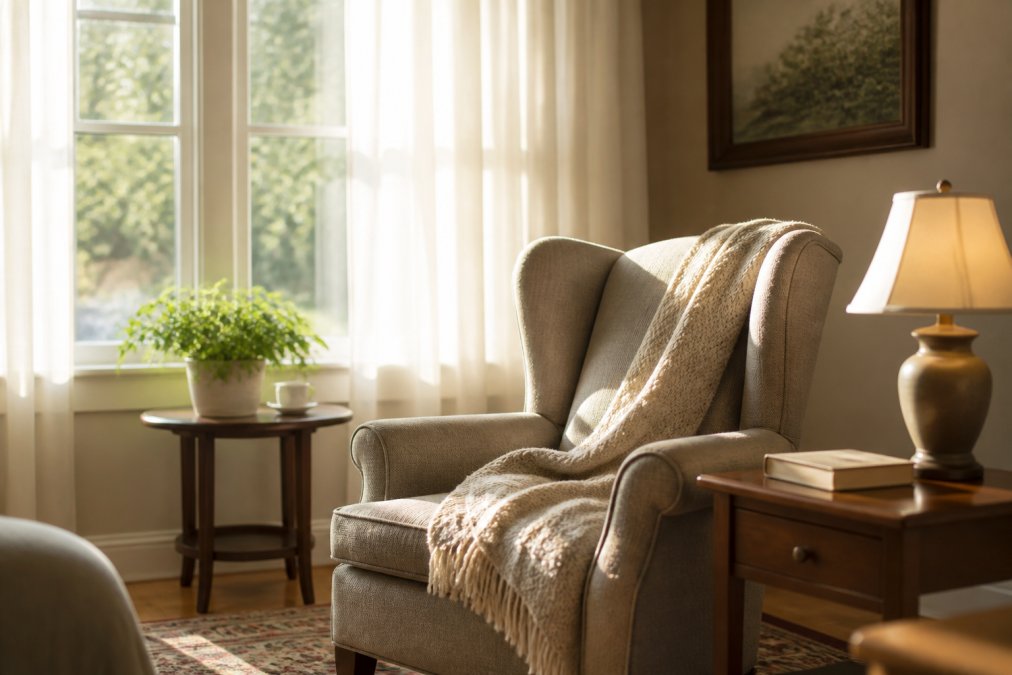
Lighting That Supports Sleep and Orientation
The body clock that governs sleep, appetite, and mood is set almost entirely by light exposure in the first hours after waking. Two levers matter most:
- Morning light. Aim for 30 to 60 minutes of bright, indirect daylight before mid-morning (peer-reviewed research). Open curtains as soon as the person is up, and if the room faces away from the sun, a 10,000-lux light box used for about 30 minutes at the same time each morning is the standard tool practitioners recommend for older adults with disrupted sleep-wake cycles.
- Evening dimming. In the two hours before bed, switch off overhead fixtures and rely on lamps of 2,700K or warmer (peer-reviewed research). Blue-rich light after dusk suppresses melatonin and pushes sleep later, which is the opposite of what a person with sundowning patterns needs.
For orientation, light the path, not the room. Nightlights placed at knee height along the route from bed to bathroom, plus a lit bathroom threshold, prevent the disorientation that causes nighttime wandering. Motion-sensing plug-in units cost a few dollars each and remove the need to find a switch in the dark.
Noise Control and Quiet Zones
Constant background noise, a television left on for company, hallway traffic, a humming refrigerator, keeps the nervous system in a low-grade alert state. For someone with hearing loss or cognitive decline, that load shows up as irritability, repeated questions, and refusal to participate.
Practical targets and fixes:
- Keep the care room under roughly 45 decibels during rest periods, about the level of a quiet library (the CDC). A free sound-meter app on a phone is accurate enough to find the worst offenders.
- Treat hard surfaces. Area rugs with non-slip backing, upholstered furniture, fabric wall hangings, and acoustic curtains absorb reflected sound. In a room with bare floors and bare walls, a single rug and two soft chairs can cut perceived echo noticeably.
- Separate sound sources. Move the television out of the main sitting area, or use closed captions with the volume low. Two competing audio streams, TV plus conversation, are harder to filter than either alone.
- Build one true quiet zone. A corner chair with a side table, a lamp, and a door that closes gives the person a place to reset when a room feels overwhelming. It should not double as a storage area or a walkway.
Space and Layout That Reduce Decisions
Layout is the third variable, and it is the one families most often overlook. The goal is a space where the next step is obvious without instruction.
- Clear a 36-inch path through main walkways, the width a walker or wheelchair needs to turn and pass comfortably.
- Anchor furniture to walls and remove low coffee tables, floor plants, and cord runs that catch feet or walker wheels.
- Keep the most-used chair, the lamp, the remote, and a glass of water within arm's reach of one seated position, so the person does not have to stand and search.
- Reduce visual clutter on counters and shelves. Too many objects competing for attention makes it harder to find the one that matters, the medication, the phone, the bathroom door.
A common pattern in homes we visit: the family has already bought the right equipment but placed it in the wrong room. A grab bar in a bathroom nobody uses, a nightlight in a hallway that is already lit, a recliner facing a wall. Design works when it follows the person's actual daily path, not the room's original purpose.
Dementia-Friendly Home Modifications That Reduce Confusion
Dementia-friendly home modifications reduce confusion by making the environment self-explanatory. The goal is fewer decisions, fewer surprises, and clear visual cues at every turn.
- Label cabinets and drawers with words or pictures
- Keep frequently used items in the same spot every day
- Remove clutter from counters and hallways
- Use contrast tape on stairs and thresholds
- Install grab bars in the bathroom before they're needed
A common mistake is redecorating all at once. Familiarity is comfort for someone with cognitive decline, so change one thing at a time.
Steady Routines and Active Communication for Emotional Balance
Steady routines and active communication are the two most reliable tools for emotional balance in geriatric care. Predictability lowers anxiety; clear communication lowers frustration. But the value is in the specifics, what the routine actually contains, and what you say when it falls apart.
Building a Routine That Holds
Structure the day around fixed anchors: wake time, meals, medication, a walk, and bedtime. Keep them within the same hour each day. What most guides skip is the shape of the routine between anchors.
A workable pattern for many households:
- Morning: light on, medication, breakfast, a short walk or chair exercises, the highest-demand activity goes here, when energy and orientation are best.
- Midday: the main meal, then a rest period with the television off. Rest is not optional; it is what makes the afternoon tolerable.
- Afternoon: one low-stakes activity, folding towels, looking at photos, a simple card game. Purpose, not productivity.
- Evening: dim lights, quiet music, a warm drink, the same wind-down sequence in the same order every night.
Two rules make routines stick. First, sequence matters more than clock time, if breakfast is always followed by dressing, the person can predict the next step even if breakfast runs late. Second, change one thing at a time. Familiarity is comfort for someone with cognitive decline, so a new routine layered on top of an old one creates confusion, not structure.
Communication That Lowers Frustration
Communication in geriatric care is less about what you say and more about how much you ask the person to process at once. Working memory and word-finding slow with age and slow further with cognitive decline, so the caregiver's job is to reduce the load.
- Get in front of the person and at eye level before speaking. Speaking from behind or from another room forces the brain to locate the source before it can process the words.
- One idea per sentence. "It's time for your shower" beats "Let's get you cleaned up before lunch because we have the aide coming at noon."
- Ask one question at a time, and wait. A pause of five to ten seconds is normal processing time for an older adult; filling it with a repeat question restarts the clock.
- Offer two acceptable choices, not one instruction. "Do you want the blue shirt or the gray one?" preserves independence while still getting the job done.
- Validate before you redirect. "You're right, it is frustrating that the phone isn't working. Let's have a cup of tea while I look at it." Naming the emotion first lowers the temperature; correcting the fact first raises it.
When the Routine Breaks Down
Every routine fails eventually, a doctor's appointment, a bad night, a holiday. What matters is how the caregiver responds, because matching agitation with agitation is what turns a bad hour into a bad day.
A short de-escalation sequence that works in most homes:
- Lower your own volume and slow your speech before you say anything. The person reads your face and tone before your words.
- Stop the demand. If the shower is the trigger, drop the shower for now. The task can wait; the relationship cannot.
- Change the setting. Move to a different room, step outside, or put on familiar music. A change of scene interrupts the loop.
- Re-engage with something easy, a snack, a photo, a hand to hold, then return to the task later if it still matters.
This is also where the environment and the human element meet. A quiet zone, dim evening light, and a predictable afternoon rest make the de-escalation sequence work faster, because the person is already starting from a lower baseline. Staff and family caregivers who understand this respond to agitation without matching it, and that is the difference between a household that stays calm and one that escalates.
Reducing Caregiver Burnout Through Environment and Support
Reducing caregiver burnout through environment means designing the home so the caregiver isn't the only source of calm. Family caregivers who never step away tend to burn out, and burnout shows up as impatience, which the person receiving care notices immediately.
Build small breaks into every day, not just emergencies. A respite caregiver who comes for a few hours weekly gives the primary caregiver real recovery time and keeps the household steady.
| Challenge | Environment Fix | Who It Helps |
|---|---|---|
| Evening agitation | Dim lights, quiet activity after dinner | Senior and caregiver |
| Caregiver exhaustion | Scheduled respite hours | Primary family caregiver |
| Nighttime wandering | Nightlights, door alarms | Senior safety |
| Mealtime resistance | Same table, same time daily | Routine and appetite |
How Technology and Staff Training Build a Supportive Care Environment
Technology and trained staff extend what a family can do alone. Smart speakers can play calming music on a schedule, automatic nightlights remove dark hallways, and video doorbells let a caregiver check in without walking the whole house.
Training matters just as much as equipment. Caregivers who understand dementia care, compassionate touch, and de-escalation respond to agitation without matching it. That's the difference between a household that stays calm and one that escalates.
Katys home healthcare has provided 24/7 home care for over a decade, and our caregivers are trained to build this kind of environment in the home rather than only in a facility.
Frequently Asked Questions
What is the best environment for someone with dementia?
A calm and supportive care environment for dementia includes natural light during the day, minimal background noise, and familiar objects placed consistently. Keep pathways clear, label doors and drawers, and set the thermostat to a comfortable temperature. Reduce clutter and glare, which can cause overstimulation. A predictable layout helps with patient orientation and lowers agitation. Small changes like these support emotional balance and make daily activities easier for both the person with dementia and their caregiver.
How can caregivers reduce stress in a home care setting?
Reducing caregiver burnout through environment starts with creating a calm space for yourself as well. Set up a quiet zone where you can take short breaks, use a white noise machine to mask disturbing sounds, and keep care supplies organized so you are not searching for items during stressful moments. Ask family members or a professional home care agency for respite. Even 30 minutes of uninterrupted rest can improve your patience and decision-making. Steady routines also lower stress for everyone in the home.
What role does routine play in a supportive care environment?
Steady routines give seniors a sense of stability and control, which reduces anxiety and confusion. Try to keep wake-up times, meals, medication schedules, and bedtime consistent each day. Use visual cues like a large calendar or a whiteboard to reinforce the plan. When routines are predictable, daily activities become easier and seniors are more likely to participate. This structure also helps caregivers stay organized and reduces the chance of missed tasks. A calm and supportive care environment depends on consistency.
How does a calm environment impact senior behavioral health?
A calm environment lowers overstimulation, which is a common trigger for agitation, aggression, and withdrawal in seniors with cognitive decline. Soft lighting, reduced noise, and familiar surroundings help regulate emotions and support better sleep. When seniors feel safe, they are more likely to engage in social interaction and daily activities. This improves overall well-being and can slow the emotional effects of cognitive decline. Creating this kind of space is a core part of person-centered care and geriatric medicine best practices.
A calm home doesn't happen by accident, and it's hard to sustain alone. Katys home healthcare provides 24/7 caregivers with over a decade of experience, trained in dementia care, compassionate touch, and person-centered routines that keep seniors steady and families supported. Get started with Katys home healthcare and build a calmer, more supportive environment for the person you love.