 ultimate-guide
Is 24/7 Home Care Worth It for Veterans in 2026?
Table of Contents
- What 24/7 Home Care Actually Looks Like for a Veteran
- VA Aid and Attendance Benefits: What They Cover
- The VA Homemaker and Home Health Aide Program Explained
- The Real Cost of 24/7 Home Care for Veterans
- How to Apply for VA Home Care Benefits
- When 24/7 Home Care Is Worth It: A Decision Framework
- Frequently Asked Questions
Last Updated: September 17, 2026
What 24/7 Home Care Actually Looks Like for a Veteran
For a wartime veteran who wants to stay home, 24/7 care means a caregiver is present at all hours, helping with tasks age or disability has made difficult. This guide explains what that support involves, what the VA covers, and how to decide if it fits your family.
Homemaker Services vs. Home Health Aide Care
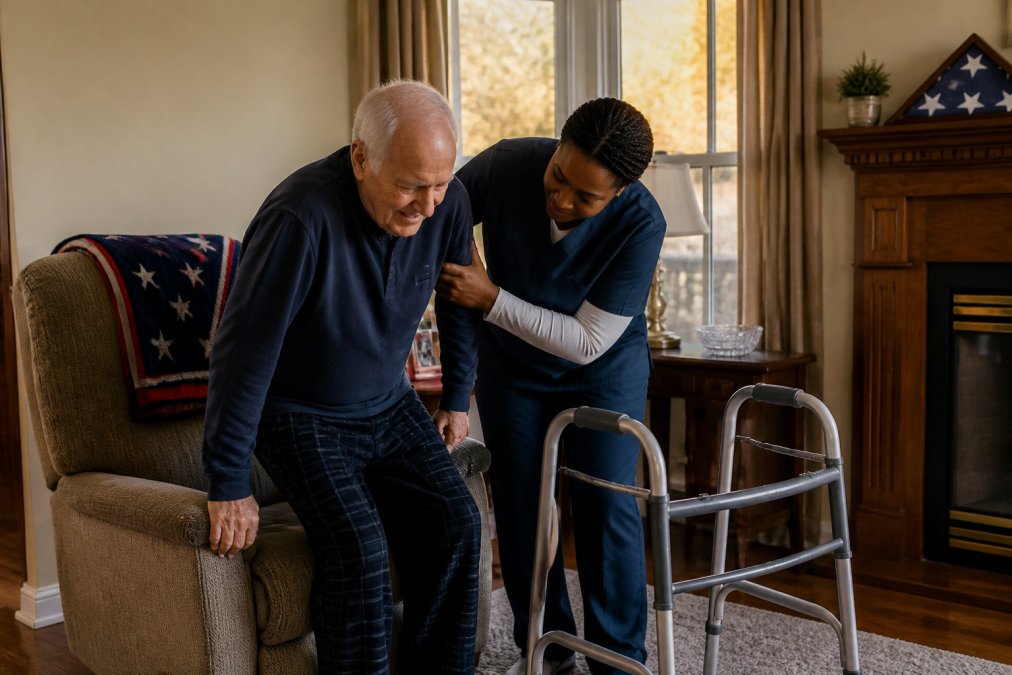
Homemaker services cover non-medical assistance: cooking, light housekeeping, laundry, grocery runs, and supervision. Home health aide care adds hands-on personal care such as bathing, toileting, transfers, and prescribed exercises.
- Homemaker: non-medical assistance, no clinical training required
- Home health aide: personal care and health-related tasks under a care plan
- Skilled nursing: clinical care ordered by a physician, a separate category entirely
- Custodial care: help with daily living that is not medically necessary, which most insurance does not cover
VA Aid and Attendance Benefits: What They Cover
VA Aid and Attendance is a monthly pension benefit added to a veteran's VA pension or survivors pension for those who need help with daily living. (Aid And Attendance Benefits And Housebound Allowance) It serves veterans and surviving spouses who require personal care, are bedbound, or live in a nursing home because of disability.
Who Typically Qualifies
- A wartime veteran who served during a recognized period of conflict
- A surviving spouse who was married to the veteran at the time of death
- Someone who needs help with at least two ADLs, or who is bedbound or in a nursing home
- A veteran whose income and net worth fall below the VA's annual limits (these change yearly, check the current VA pension page)
Aid and Attendance is not service-connected disability compensation, a veteran can be eligible for one, both, or neither. It is also not the VA Homemaker and Home Health Aide program, a clinical service delivered through a VA medical center rather than a cash benefit. Confusing the two is the most common reason families apply for the wrong thing and wait months for a decision that was never going to go their way.
The Evidence Standard That Actually Decides the Claim
Most A&A denials are about documentation, not eligibility. The VA reviewer wants a physician statement describing functional limitations in daily life, not a diagnosis, prognosis, or medical history summary.
What a strong statement includes:
- The specific ADLs the veteran cannot perform without assistance (bathing, dressing, transferring, toileting, eating)
- How often assistance is needed (daily, several times a day, overnight)
- Whether the veteran is bedbound or requires protective supervision
- The date the limitations began
What a weak statement includes:
- A diagnosis alone ("patient has Parkinson's disease")
- Vague language ("patient has difficulty with daily activities")
- A prognosis without functional detail
How the Benefit Is Paid
Aid and Attendance is paid monthly, in arrears, to the veteran or surviving spouse, not to the agency, and not in advance. You must cover the care invoice for the first month or two before the benefit arrives. If the veteran already receives a VA pension, the A&A amount is added to that payment.
What A&A Does Not Cover
- It does not pay for skilled nursing care ordered by a physician
- It does not cover the full cost of 24/7 care in most cases
- It does not replace the VA Homemaker and Home Health Aide program
- It does not cover room and board in an assisted living facility unless the veteran is already eligible for pension
The VA Homemaker and Home Health Aide Program Explained
The VA Homemaker and Home Health Aide program provides in-home support to eligible veterans through VA-contracted agencies, at no cost. It is separate from Aid and Attendance and aimed at veterans enrolled in VA health care who need help to remain at home.
VA Homemaker and Home Health Aide Care program page
The Real Cost of 24/7 Home Care for Veterans
Continuous care is the most expensive home care arrangement, driven almost entirely by labor hours: multiple caregivers working shifts plus agency overhead. Any agency that quotes a number before assessing your parent is guessing.
What Drives the Monthly Number
Four variables move the price more than anything else:
- Hours per week. 168 hours is the ceiling for true 24/7 coverage. Most families start at 40-60 hours and scale up as needs increase.
- Level of care. Homemaker-level support (cooking, light housekeeping, companionship) costs less per hour than home health aide care (bathing, toileting, transfers, prescribed exercises).
- Live-in vs. shift coverage. A live-in caregiver is one person who sleeps on-site and is paid a flat rate; shift coverage is two or three caregivers rotating, which costs more but guarantees an awake caregiver at 3 a.m.
- Geography and agency overhead. Rural coverage, weekend differentials, and holiday rates all add to the base.
A common pattern: the first month of 24/7 care costs more than expected, because the assessment that sets the care plan happens after care has started. Ask for the assessment before you sign anything.
The Funding Stack, In Order of What to Pursue First
| Funding Source | What It Covers | Key Limitation |
|---|---|---|
| VA Aid and Attendance | Monthly cash benefit toward care | Paid to the veteran, not the agency; must meet eligibility; reimbursed after you pay |
| VA Homemaker/Home Health Aide | Set hours through a VA-contracted agency | Not typically 24/7; based on clinical assessment; no cost to the veteran |
| VA respite care | Short-term relief for the family caregiver | Limited days per year; not a long-term solution |
| Medicaid (state-based) | Custodial care for those who qualify | Strict income and asset limits; 5-year look-back applies |
| Long-term care insurance | In-home care if the policy includes it | Must have been purchased in advance; daily benefit caps |
| Private pay / family funds | Any remaining gap | No cap; scales with hours needed |
Whether 24/7 home care is worth it depends less on sticker price than on what the alternative costs: a nursing home placement, repeated hospital readmissions, or a family caregiver quitting a job all carry their own price, usually invisible until they hit.
The Financial Planning Gap Most Guides Skip
Most articles stop at "apply for Aid and Attendance." Here is what happens when VA benefits do not cover the full cost of 24/7 care.
Do not drain a parent's assets to pay for care before checking Medicaid eligibility rules. Improper transfers can trigger a penalty period that delays coverage exactly when you need it most. Talk to an elder law attorney or your state Medicaid office before you move a single dollar.
A Simple Way to Frame the Decision
Add up three numbers: the monthly cost of 24/7 care, the monthly value of VA benefits the veteran qualifies for, and the monthly cost of the realistic alternative (nursing home, family caregiver leaving a job, or repeated hospitalizations). The gap between the first number and the sum of the other two is your true out-of-pocket cost, the number to plan around, not the headline price an agency quotes.
How to Apply for VA Home Care Benefits
Applying starts with determining which benefit fits, then submitting the right paperwork with supporting medical evidence.
- Confirm the veteran's eligibility, including wartime service and discharge status.
- Enroll in VA health care if not already enrolled, since the Homemaker and Home Health Aide program runs through it.
- Request a clinical assessment through the local VA medical center to establish care needs.
- For Aid and Attendance, file VA Form 21P-534EZ with medical evidence describing functional limitations.
- Gather supporting documents: DD-214, marriage certificate for surviving spouses, and physician statements.
- Submit and track the claim, responding quickly to any VA requests for more information.
What to Do If Your Claim Is Denied
A denial is not the end. Most denials come down to missing evidence, not ineligibility, and the appeals route is well defined.
- Read the decision letter carefully and note the specific reason for denial
- Request a decision review within the deadline stated in your letter
- Choose the review lane that fits: a supplemental claim with new evidence, a higher-level review, or a Board appeal
- Add the missing piece, usually a more detailed physician statement or a service record
- Keep copies of everything you submit and note the date of each filing
When 24/7 Home Care Is Worth It: A Decision Framework
- Is your parent safe alone overnight, or is there a real fall, wandering, or medication risk?
- Has there been a recent hospitalization or a decline that a few weekly hours cannot address?
- Is the primary family caregiver burned out, injured, or unable to sustain the schedule?
- Does the veteran qualify for Aid and Attendance or the VA Homemaker program to offset cost?
- Would the alternative be a nursing home, and is that what your parent wants?
The right question is not "can we afford 24/7 care?" It is "what does the alternative cost, in money, health, and family strain?" Once you frame it that way, the decision usually becomes clearer.
Quality of life rarely shows up in a spreadsheet but matters most. A veteran who remains at home, keeps familiar routines, and avoids institutional placement often maintains better function and mood, the entire point of in-home support.
Frequently Asked Questions
Will the VA pay for 24-hour home care?
The VA does not typically fund around-the-clock care through a single program. Instead, veterans may combine VA Homemaker and Home Health Aide services, Aid and Attendance benefits, and other VA programs. Aid and Attendance adds a monthly payment on top of an existing VA pension for veterans who need help with daily activities like bathing, dressing, or mobility. The Homemaker and Home Health Aide program provides in-home support based on a clinical assessment. Many families use these benefits alongside private-pay 24/7 home care to reduce out-of-pocket costs.
How does the VA Aid and Attendance benefit work for home care?
Aid and Attendance is a monthly benefit added to a VA pension for veterans who need help performing activities of daily living or who are bedridden. To qualify, a veteran generally must meet income and asset limits and have a clinical need documented by a VA examination or physician. The extra payment can be used toward the cost of 24/7 home care, though it rarely covers the full expense. A surviving spouse of a wartime veteran may also qualify. Check the VA's official website for current eligibility rules and payment amounts.
What is the difference between VA Homemaker and Home Health Aide care?
Homemaker services cover non-medical tasks like meal preparation, light housekeeping, laundry, and companionship. Home Health Aide care includes personal care such as bathing, grooming, medication reminders, and mobility assistance. A VA clinical assessment determines which services a veteran needs and how many hours per week the VA will authorize. Both programs aim to help veterans remain safely at home, but neither typically provides 24/7 coverage on its own. Families often supplement with private-pay caregivers to fill the gap.
What criteria determine if a veteran qualifies for in-home support?
Eligibility generally depends on three factors: the veteran's service history (including wartime service for pension-based benefits), a clinical need for help with activities of daily living, and income and asset limits. A VA social worker or clinician conducts an assessment to determine the appropriate level of care. Veterans with a service-connected disability may qualify through different programs with different rules. Because criteria vary by program, families should contact the VA directly or work with an accredited representative to review their specific situation.